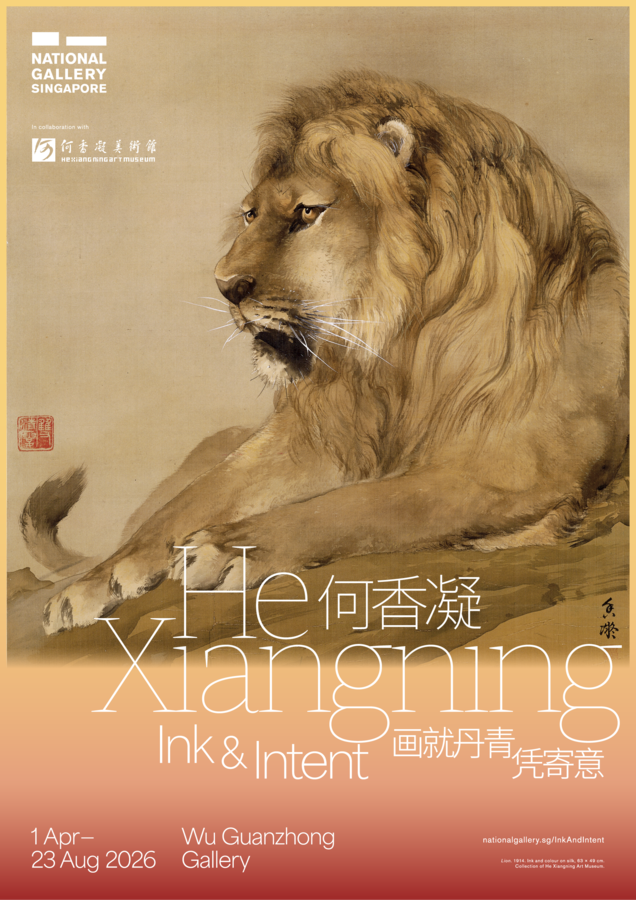
Exhibition Dates
2026.4.1 To 2026.8.23
Venue
National Gallery Singapore
Wu Guanzhong Gallery
Organizers
National Gallery Singapore
He Xiangning Art Museum
Among writings on Chinese painting, The History of Painting from the Jade Terrace (Yutai huashi), compiled by Tang Shuyu (1795–1855), stands out as a work devoted to women painters. In the form of a comprehensive historical survey, it documents women’s artistic practices across diverse backgrounds, including the imperial household, elite families, concubinage and the courtesan world. By the 20th century, “women’s art” had come to be regarded as a key component of what was often termed the “new art history.” Scholarship on women’s art history thus moved beyond the historiographical limits of Tang Shuyu’s framework. Works such as Linda Nochlin’s “Why Have There Been No Great Women Artists?” (1971) and Whitney Chadwick’s Women, Art, and Society (1990) opened up a much broader scholarly field. Shifts in art-historical perspectives were inseparable from broader transformations of their time.
In 1924, He Xiangning (1878–1972) proposed commemorating International Women’s Day on 8 March. She advocated gender equality and took part in organising women’s movements. Her actions represented not only her personal independence and agency but may also be read as a “self-portrait” of modern Chinese women in the 20th century. In 1903, He Xiangning went to Japan to study. She was among the few foreign students there and one of the few women studying abroad at the time.
Unlike students who went abroad to solely pursue art, He Xiangning’s artistic pursuits stemmed from revolutionary commitment and this became a life-long conviction. Her artistic outlook aligned with the “art revolution” advanced by artists known as the “Two Gaos and One Chen” (Gao Jianfu, Gao Qifeng and Chen Shuren), who were active in the Lingnan region during this period. Within the context of this new historical moment, art continued to carry the sensibilities of the traditional intellectual; yet, like women of the 20th century, it moved beyond the narrow confines of self-indulgence, turning instead towards social concerns.
Like the Lingnan School painters and contemporaries in other regions engaged in “art revolution,” He Xiangning regarded art as a means through which social change and political transformation could be articulated. For her, art gave form to human thought and responded to the needs of society and its time. Guo Moruo’s once described He Xiangning’s art in these terms: “Revolution is art at its highest form. Madam He’s revolutionary undertaking and artistic activities have become one.” This assessment remains compelling. The relationship between revolution and art was a central concern of 20th-century artistic practice, and it remains a critical proposition in contemporary art-historical discourse.
Since its establishment in 1997, the He Xiangning Art Museum has consistently centred its work on He Xiangning and on women’s art, staging a series of research-based exhibitions such as He Xiangning and Southeast Asia and He Xiangning and Twentieth-Century Women. This exhibition in Singapore, conceived as a scholarly-thematic exhibition, features carefully selected works and archival materials through three interrelated perspectives: regional connections, women and art. Through this approach, the exhibition seeks to elucidate He Xiangning’s artistic explorations and, in turn, to reflect on a century of modern art-historical inquiry into women’s identity, women and art, and women and society. As part of an ongoing series of thematic research exhibitions, we aim to foster dialogue and expand the depth and breadth of scholarship.